
Quick Summary
The best tweezers depend on your most frequent task: slant-tip tweezers suit brow shaping, while pointed tips suit detail extraction. Check that the tips meet evenly before buying, since misalignment lets short hairs slip free.
- Slant-tip tweezers have an angled edge that sits flush against the skin for clean brow lines.
- Pointed tips reach very short or deeply rooted hairs that flat or angled edges cannot grip.
- Close the tweezers on a strand of thread and pull gently to test tip alignment before purchase.
- Start with one slanted tip for brows and one pointed tip for detail.
- The Nghia straight-blade pairs at $5.65 give a reliable budget starting point.
Table of Contents
- Why Tweezer Choice Matters for Beauty Work
- Types of Tweezers and Where Each One Fits
- Slant-Tip Tweezers for Precision Shaping
- Pointed-Tip Tweezers for Detail and Extraction
- Eyebrow Tweezers: Choosing the Right Size and Tip
- Stainless Steel Construction, Grip Comfort and Hand Fatigue
- Keeping Your Tweezers Clean and Disinfected
- Stocking Your Kit: Choosing Your Next Pair
- Frequently Asked Questions
Which Tweezers Are Worth Buying for Beauty Work?
Last Updated: November 1, 2026
Why Tweezer Choice Matters for Beauty Work
Tweezers look simple, but the wrong pair can make every shaping session harder than it needs to be. A tool that pinches, slips or fits the hand badly turns a quick brow clean-up into a frustrating twenty minutes. The right tweezer gives you clean grip, clear sight lines and control on every hair.
This practical guide will help you choose. Tweezers are a small purchase, but they get used every day, so the choice matters more than the price tag suggests. Shape, tip, size and steel all change how the tool performs on a real client.
Tweezers are precision instruments for grasping and removing individual hairs. Good ones hold a fine edge, close evenly and stay comfortable through a long session. Poor ones bend, misalign or leave the tips too blunt to catch short hairs.
Types of Tweezers and Where Each One Fits
Most beauty tweezers fall into a few shape families. Each one suits a different job, so start with the work you do most often rather than the tool that looks best in a photo.
- Slant-tip tweezers have an angled edge that sits flush against the skin. They suit brow shaping and clean lines.
- Pointed-tip tweezers taper to a fine point for lifting very short or deeply rooted hairs.
- Straight-edge tweezers grip broader hairs and are useful for general clean-up.
Shape matters most when you are working close to the skin. Choose the family that matches your daily tasks, then narrow down by tip and size.
Slant-Tip Tweezers for Precision Shaping
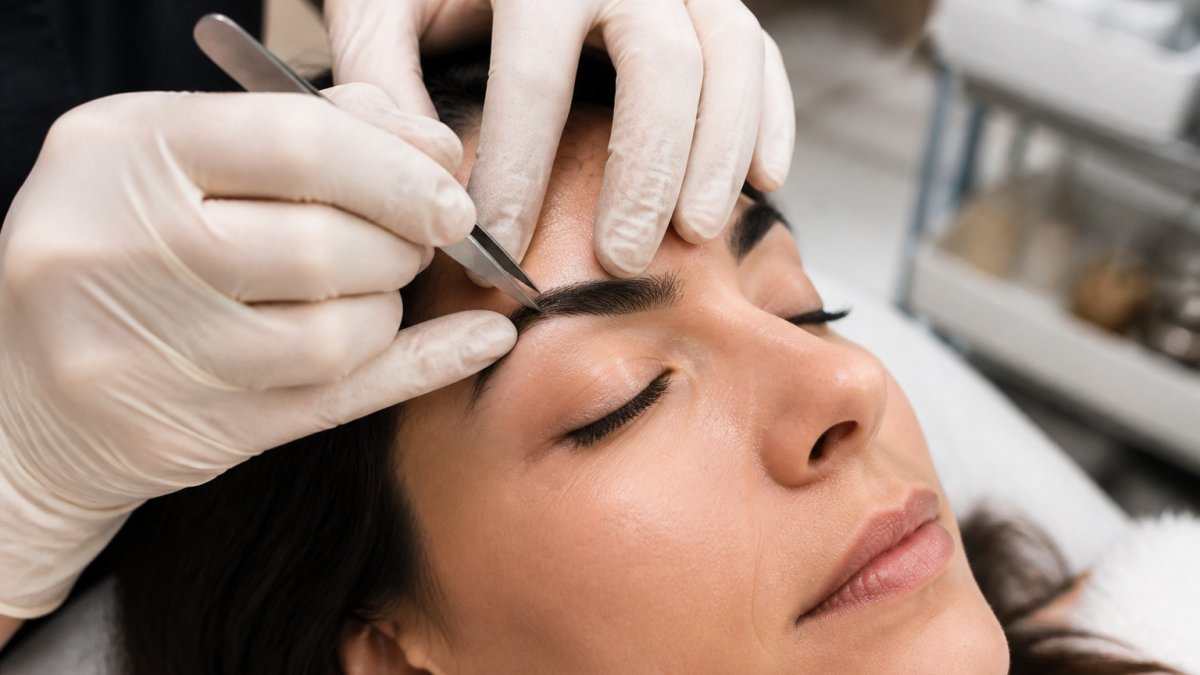
Slant-tip tweezers are a common first choice for brow work. The angled edge lets you grip hairs at skin level, which keeps lines tidy and reduces the chance of missing a stray hair.
Look for a clean, even alignment when the tips close. If the edges meet unevenly, short hairs slip free and you end up re-gripping again and again. Test the tool by closing it on a strand of thread before you use it on a client.
A common mistake is buying a slant tip that is too wide for detailed work. A narrower slant gives finer control on the arch and tail of the brow.
Pointed-Tip Tweezers for Detail and Extraction
Pointed tips are built for fine detail. They reach short hairs and small splinters that a flat or angled edge cannot grip. This is the shape most often used for detailed extraction work.
Pointed tips need a precise tip closure. If the points do not meet, they will not hold. Check that the two tips line up on the same plane before you commit to a pair. For detail extraction, see an ultra-fine pointed electrolysis tweezer.
Keep pointed tweezers for detailed tasks rather than heavy pulling. Fine tips can bend under too much force, so match the tool to the job.
Eyebrow Tweezers: Choosing the Right Size and Tip
Size and tip shape work together. A slanted tip in a size 4 gives a different feel than a narrow slant in a size 3.5, and the difference shows up quickly in long sessions. Pick the tip that matches the hair you remove most often.
The MBI-401 Eyebrow Tweezer Slanted Size 4 is available for $8.25. The MBI-403 Eyebrow Tweezer Slanted Narrow Tip Size 3.5 is also $8.25.


If you prefer a straight claw, the Nghia Stainless Steel Straight Blades Eyebrow Tweezer N-406 at $5.65 and the Nghia Stainless Steel Straight Blades Eyebrow Tweezer N-408 at $5.65 are available.

| Tool | Tip Shape | Price (CAD) | Best For |
|---|---|---|---|
| MBI-401 Slanted Size 4 | Slanted | $8.25 | General brow shaping |
| MBI-403 Slanted Narrow Size 3.5 | Narrow slant | $8.25 | Fine detail work |
| Nghia N-406 Straight Blades | Straight | $5.65 | Straight-line grooming |
| Nghia N-408 Straight Blades | Straight | $5.65 | Straight-line grooming |
| CNBS Professional Implement | Professional | $6.00 | Everyday implement use |
Stainless Steel Construction, Grip Comfort and Hand Fatigue
"Stainless" is a family of alloys, not a single specification. The grade and finish change how a pair holds an edge, how it behaves under repeated disinfection, and how long the tips stay aligned.
MBI-401 Eyebrow Tweezer Slanted Size 4' →
What the steel grade actually changes
Finish matters as much as alloy. A matte or brushed finish hides fingerprints and resists slipping in gloved hands; a high polish wipes clean easily but shows every smudge. Ask about the finish and the tip alignment, not only the word "stainless."
Tip alignment: the check that predicts performance
A pair can be made of excellent steel and still fail if the tips do not meet on the same plane. Close the tweezers and hold them up to a light source: you should see an even line of contact with no gap at the point. Then grip a single strand of thread and pull gently, if it slips, the edges are misaligned and short hairs will slip too. This check takes seconds and tells you more than the price tag.
Grip, spring tension and hand fatigue
Hand fatigue is cumulative, and it comes from three variables most buyers never compare:
- Spring tension. A stiff spring requires more force per pinch; over a full day of appointments that force adds up in the thumb and forefinger. A lighter spring reduces effort but can feel vague on very short hairs. Test the closing force before you commit.
- Weight and balance. A heavier tool feels stable but tires the hand sooner; a lighter tool is easier to control for fine work. Look for a pair that balances near the middle of the body so the tips do not feel tip-heavy.
- Body shape and grip surface. Flat or textured bodies resist rolling and give a more secure hold in gloves. Rounded, polished bodies look clean but can rotate in the hand during a long session.
If you can, hold the tool before buying and close it a dozen times, the pair that feels slightly easier in the hand is usually the one that survives a week of clients.
Keeping Your Tweezers Clean and Disinfected
For anyone using tweezers on clients, cleaning is a sequence with distinct stages, and the stage you choose depends on what the tool touched.
1. Cleaning (every use)
Cleaning removes visible debris; it does not kill pathogens. After each client, open the tips and remove hair, skin cells and product residue with a soft brush or a lint-free wipe. Pay attention to the hinge area and the inside faces of the tips, where debris collects and quietly misaligns the tool. Rinse if the manufacturer allows it, then dry fully, moisture left in the hinge is what drives corrosion and stiff action.
2. Disinfection (between clients)
Disinfection reduces pathogens on the tool. Use a disinfectant labeled for the contact time you can actually meet, and follow the label rather than a habit. Two practical points:
- Contact time is not optional. A quick wipe and immediate reuse does not give the product time to work. Check the label and let the tool sit for the full contact time.
- Some disinfectants corrode steel. High-level products can dull tips and pit the finish over time. Check that the product is compatible with stainless steel, and rinse or wipe off residue as the label directs before storage.
3. Sterilization (where the setting requires it)
Sterilization destroys all microbial life and is a higher bar than disinfection. It is typically required where tools contact broken skin or where a regulator or health authority sets that standard for the setting. Methods include steam autoclave and dry heat, and each has limits: heat and moisture cycles can affect tip alignment over time, so inspect the tool after every cycle and retire any pair that no longer closes evenly. Sterilization protocols vary by product and by the rules that apply where you work. Maintaining such rigorous hygiene standards ensures that your instruments remain safe for delicate skin work, a principle that also applies when incorporating facial massage tools into your regular routine.
Storage and inspection
Store tweezers in a dry, closed container with the tips protected so they stay aligned and free of contamination. Inspect the tips regularly for bends, chips or wear, and replace any tool that no longer closes evenly, a worn tip is a hygiene problem as well as a performance one, because debris collects in the gap.
Stocking Your Kit: Choosing Your Next Pair
Start with one slanted tip for brows and one pointed tip for detail, then add a specialty shape as your work grows. This keeps your kit focused and avoids buying tools you will rarely use.
For a tighter budget, the Nghia straight-blade pairs at $5.65 give a reliable starting point. If you want a slant with a finer edge, the MBI-403 at $8.25 is the next step up.
Our recommendation is simple: pick the tip that matches your most frequent task, check the alignment before you buy, and choose the steel you can clean and maintain consistently. Browse the full range at Classique Nail Supply and build the kit that fits your clients.
Frequently Asked Questions
Who has the best tweezers?
No single brand wins for every job. The best pair depends on the task: slant tips suit brow shaping, pointed tips suit detail and extraction work. Classique Nail Supply stocks several options, including the MBI-401 slanted eyebrow tweezer at $8.25 and the Nghia N-406 straight-blade stainless steel tweezer at $5.65.
Can you bring tweezers on a plane?
Airport security staff make the final call on any item in carry-on luggage. Check the rules with your airline before departure, since policies can change.
What is the difference between slant-tip and pointed-tip tweezers?
Slant-tip tweezers have an angled edge that lets you grip hairs along the brow line and shape arches cleanly. Pointed-tip tweezers close to a fine point, which helps with isolating a single hair or removing splinters and ingrown hairs. Many technicians keep one of each. The MBI-403 slanted narrow-tip tweezer is $8.25, and the CNBS Professional Implement Tweezer is $6.00.
How do you clean and disinfect tweezers?
Clean tweezers after every client. Remove debris with soap and warm water, dry them completely, then disinfect with an approved hospital-grade disinfectant or 70% isopropyl alcohol, following the product's contact time. Store them in a clean, closed container. Replace tweezers that no longer close properly.
