
Table of Contents
- Why Identifying Authentic Nail Brands Matters
- Step 1: Verify Authorized Professional Nail Product Distributors
- Step 2: How to Spot Fake Nail Products Before Purchase
- Step 3: Reading Professional Nail Product Safety and Ingredient Labels
- Step 4: Questions to Ask a Nail Product Supplier
- Step 5: Verify Authenticity Using Digital Tools and Customer Feedback
- What to Do If You Suspect a Counterfeit Purchase
- Frequently Asked Questions
Last Updated: October 7, 2026
Why Identifying Authentic Nail Brands Matters
Counterfeit gel polish, acrylic systems, and nail varnish can damage nails, ruin your reputation, and waste money, which is why it's critical to identify authentic nail brands.
At Classique Nail Supply, we help nail technicians and salon owners source genuine professional-grade products.
You don't need to be an expert to spot fakes. A few simple checks catch most counterfeits before they reach your salon chair.
Step 1: Verify Authorized Professional Nail Product Distributors
The safest way to buy authentic nail products is through authorized retailers, since counterfeiters rarely bother with official channels.
Check the brand's official website for approved retailers
Every legitimate nail brand maintains a list of approved distributors. Visit the brand's official site and look for a "Where to Buy" or "Authorized Retailers" page; if none exists, contact customer service directly. Authorized distributors stock fresh inventory with current batch numbers, honor warranties, and handle returns properly, unauthorized sellers usually can't.
Confirm the distributor's business registration and credentials
A legitimate distributor has verifiable credentials: a business registration, a physical address (not a mailbox), a phone number that reaches a person, years in business, a professional website, and transparent return and warranty policies. Ask directly: "What brands do you carry and how long have you been authorized?" Legitimate distributors answer confidently; resellers and counterfeiters dodge or give vague answers.
Step 2: How to Spot Fake Nail Products Before Purchase
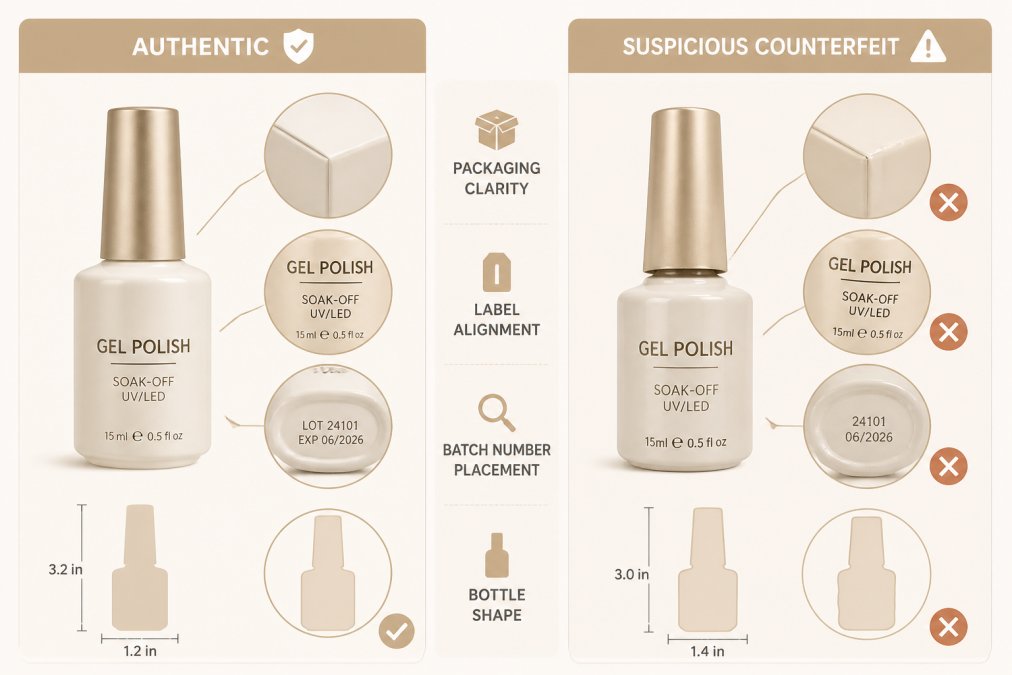
Before your order arrives, inspect the packaging and product details. Counterfeiters cut corners on packaging, labels, and batch numbers. These visual clues catch fakes 80% of the time.
Price discrepancies and unrealistic deals
If the price seems too good to be true, it probably is. Compare prices across multiple authorized distributors: a 10-15% difference is normal, a 40-50% discount is a red flag. Legitimate brands maintain pricing consistency across authorized channels, so a dramatically cheaper seller is either counterfeit or unauthorized gray-market stock.
Packaging quality and branding inconsistencies
Authentic nail polish has crisp, clean packaging: labels perfectly centered, text sharp and legible, colors matching official product photos, and bottle shapes consistent with the brand. Counterfeit packaging often has off colors, blurry printing, or misaligned labels, all signs of rushed manufacturing.
Missing batch numbers and authenticity markers
Every legitimate nail product has a batch number, which proves the product came from the manufacturer and links it to quality control records.
Look for:
- Batch number on the bottle (usually on the bottom or side)
- Date of manufacture or expiration date
- Brand logo with proper formatting
QR codes are increasingly common on authentic products. Nail Polish Market Size, Share & 2031 Growth Trends Report notes that brands are implementing QR-code verification to help customers identify genuine products.
Step 3: Reading Professional Nail Product Safety and Ingredient Labels
Legitimate nail products include detailed safety information; counterfeiters skip it or copy labels incorrectly. Knowing what to look for protects your clients and your business.
What required regulatory information should be present
Nail products sold in Canada must include specific safety and ingredient information. Check that the label contains:
- Complete ingredient list in descending order by weight
- Safety warnings and precautions
- Manufacturer or distributor name and address
The Cosmetic, Toiletry and Perfumery Association guidance on product labeling advises that identifying authentic products involves verifying that the label contains all required regulatory information. Proper labeling is a primary indicator of a legitimate, high-quality nail product.
Counterfeit products often have incomplete or missing information. If the label is vague, missing safety warnings, or doesn't list ingredients clearly, it's fake.
Understanding ingredient lists and safety data sheets
Professional-grade nail products should be formulated without harmful chemicals. Many brands now offer Hema-Free and vegan options. Check the ingredient list for what's NOT there:
- Formaldehyde or formaldehyde resin
- Dibutyl phthalate (DBP)
- Toluene
Request a Safety Data Sheet (SDS) from the distributor. Every legitimate product has one, detailing chemical composition, hazards, and safe handling. If a distributor can't provide an SDS within 24 hours, the product is likely counterfeit.
Research on nail polish composition and toxic substances from 2025 analyzed nail polish samples from national and international brands and found that authentic products consistently disclosed their full ingredient composition.
Step 4: Questions to Ask a Nail Product Supplier
Most buying guides tell you to "ask the supplier questions" but not which answers actually prove authenticity. This section fills that gap with a question set tied to verifiable evidence, plus category-specific checks.
The four questions that produce verifiable evidence
Ask these in writing (email or a marketplace message), not over the phone, so you have a record to compare against the brand's own records.
-
"Can you send your authorization letter or distributor agreement for this brand?" A legitimate distributor can produce a document on the brand's letterhead naming them as an authorized seller, usually with a territory and effective date. A reseller will deflect, claim it's "confidential," or send a screenshot of a wholesale account login.
-
"What is the batch code on the unit you'll ship, and can you confirm it against the brand?" Batch codes tie a physical unit to a manufacturer's quality-control record. A supplier who can read you the code before shipping is working from real stock; one who says "we'll pick whatever's on the shelf" isn't tracking inventory at batch level.
-
"Can you provide the Safety Data Sheet for this exact product?" In Canada, suppliers of workplace chemicals, including nail products used in salons, are expected to make safety data sheets available. An SDS follows a standardized 16-section format. If a supplier can't produce one within a business day, treat that as a stop signal.
-
"What's your return process if a unit fails a batch or label check?" Authorized distributors have a defined returns path because they can claim against the brand. Counterfeit resellers can't, so their answers get vague, "contact us and we'll see" is not a policy.
A supplier who answers three of these four confidently but dodges the batch-code question is the highest-risk profile. Batch tracking is the one thing counterfeiters genuinely cannot fake at scale.
Category-specific checks: the same questions, different evidence
Polish, gel systems, nail tips, and adhesives fail authenticity checks in different ways.
Traditional polish and lacquer. Ask for the batch code and fill date.
Gel polish and UV/LED systems. Ask whether the supplier stocks the brand's matching base and top coat in the same batch family, gel systems are formulated as a set, and counterfeiters often sell mismatched components that cure poorly or lift within days.
Nail tips, forms, and enhancement products. Ask for the material specification (ABS, gel, or acrylic) and size range.
Adhesives, primers, and bonders. These are the highest-risk category, small, cheap to fake, and hard to inspect visually.
Run a trial order before committing to bulk. Order one unit from each category you plan to stock, then verify the batch code, SDS, and label against the brand's own records. A legitimate supplier expects this and often includes documentation unprompted; a counterfeiter pushes you toward a large first order and discourages small ones.
What a good answer looks like versus a bad one
The difference is usually specificity: a good answer names a document, a code, or a date; a bad answer names a feeling.
- Good: "Our authorization is dated March 2024 and covers wholesale in your province. Here's the PDF."
- Bad: "We've been working with them for years, everyone knows us."
- Good: "The batch on the units we have now is [code], fill date [month/year]."
If you get two or more bad answers in a row, stop the conversation, there are enough authorized distributors that you don't need to gamble on an unverifiable one.
Step 5: Verify Authenticity Using Digital Tools and Customer Feedback
Digital checks are useful only when run in sequence and tied to a specific product category. This section covers the tools, the order to run them in, and what to do when a check fails.
Run the checks in this order
Order matters because each step is cheaper than the next.
**1.
2. Authorized-seller lookup (2 minutes). Search the seller's name on the brand's "Where to Buy" or "Authorized Distributors" page.
3. Reverse image search (3 minutes). Screenshot the seller's product photo and run a reverse image search.
**4.
5. Community and review check (10 minutes). Run this slowest step last.
The sequence matters more than any single tool. A seller who passes steps 1 through 4 is low-risk even without glowing reviews. A seller with great reviews who fails step 4 is high-risk regardless of what the community says.
What reviews can and can't tell you
Reviews are the weakest authenticity signal, easy to fake and easy to misread. Use them for pattern detection, not verification.
What reviews are good for:
- Spotting batch-level problems (multiple reviewers describing the same defect in the same time window)
- Identifying sellers who ship damaged or repackaged units
- Finding warnings about specific storefronts or marketplace sellers
What reviews are not good for:
- Confirming authenticity on their own, a five-star rating says nothing about whether the product is genuine
- Distinguishing a counterfeit from a legitimate product that simply didn't work for that reviewer
- Detecting sophisticated counterfeits, which often perform well enough short-term to earn positive reviews before problems surface
Filter for reviewers who mention specific details: batch codes, packaging differences, cure times, or comparisons to units bought from an authorized source. Those carry far more weight than star ratings.
What to do when a check fails
If any of the five checks fails, stop and act before the product touches a client.
Document everything. Photograph the packaging, label, batch code, and QR code result.
Escalate to the brand. Most established brands have a counterfeit-reporting channel.
Report to the marketplace. If you bought through an online marketplace, use its dedicated counterfeit-reporting process, separate from general returns.
Never resell a product you suspect is counterfeit, even at a loss. Passing it on exposes you to the same liability you were trying to avoid, and it makes you part of the problem.
A quick reference: the five-check sequence
- Cross-reference the product against the brand's official site.
- Look up the seller on the brand's authorized-distributor page.
- Reverse-image-search the seller's product photo.
- Scan the QR code or verify the batch-code format.
- Search professional communities for batch-level complaints.
If all five pass, you're in low-risk territory. If one fails, escalate to the written-verification questions above before ordering. If two or more fail, walk away, there are enough verified distributors that no single seller is worth the risk.
What to Do If You Suspect a Counterfeit Purchase
If you've already bought a product and suspect it's counterfeit, act immediately.
Stop using it, don't apply it to client nails.
Contact the distributor first, explaining your concerns and requesting a refund or replacement.
Report the counterfeiter to the brand.
Identifying authentic nail brands protects your salon, your reputation, and your clients' health.
Classique Nail Supply carries a complete selection of premium, authentic nail products from industry-leading brands. We're an authorized distributor with fast shipping across Canada and expert support to help you find exactly what you need. Global nail care market trends for 2026 shows that sourcing from established, authentic supply chains is increasingly important as the professional beauty market expands. Shop our selection and experience the difference that genuine professional-grade products make for your business.
Frequently Asked Questions
How can you tell if a nail brand is authentic?
Authentic nail brands display clear, professional packaging with complete regulatory information, consistent branding, and visible batch numbers. Verify the seller on the brand's official website, check that prices align with authorized retailer pricing, and confirm the product label includes all required ingredient lists and safety data. Counterfeit products often have spelling errors, faded logos, or missing batch codes. When in doubt, purchase directly from authorized distributors or the brand's official website.
What should you check on nail product packaging to verify authenticity?
Examine the label for sharp, clear printing without smudges or misalignment. Verify the batch number is present and matches the brand's format. Check that all required regulatory information is listed, including ingredient names and safety warnings. Authentic packaging uses consistent fonts and colors that match the brand's official materials. Look for holograms, QR codes, or security features the brand uses for verification. Counterfeit products often have poor print quality, incorrect spelling, or missing regulatory text entirely.
How do I know if a nail product supplier is legitimate?
Verify the supplier is listed on the brand's official website as an authorized retailer or distributor. Check their business registration with provincial or territorial authorities to confirm they operate legally. Ask for proof of authorization directly from the brand, and confirm their contact information matches official records. Legitimate suppliers provide clear return policies, transparent pricing, and professional customer service. Be cautious of suppliers offering unusually low prices, claiming to be 'closeout' retailers, or refusing to provide proof of authorization.
Is it safer to buy professional nail products from an authorized retailer?
Yes. Authorized retailers source directly from brands or official distributors, ensuring product integrity and safety compliance. They maintain proper storage conditions and provide accurate product information. Counterfeit or resold products may contain harmful ingredients, incorrect formulations, or contaminated batches that can damage nails or cause allergic reactions. Authorized retailers also offer recourse if a product is defective. For professional nail technicians and salon owners, purchasing from authorized distributors protects both your business reputation and client safety.