
Table of Contents
- What Beauty Schools Need From a Wholesale Nail Supply Partner
- Nail Technician Training Kit Requirements for Accredited Programs
- Gel Polish and Acrylic Systems for Classroom Use
- Opening a Professional Nail Supply Wholesale Account
- Nail Salon Inventory Loss Prevention in School Settings
- Salon Equipment, Furniture, and Spa Essentials for Training Spaces
- Shipping, Order Fulfillment, and Restocking for Schools
- Conclusion: Building a Reliable Supply Chain for the Next Generation of Nail Techs
- Frequently Asked Questions
Last Updated: September 27, 2026
What Beauty Schools Need From a Wholesale Nail Supply Partner
Running a nail program means ordering for thirty students at once, not one client. According to RevenueBase's directory of nail supply distributors, 42 nail supply distributors are headquartered in the country, and 234 beauty supply wholesalers operate here, so the options look plentiful until you try to find one that actually understands a school's calendar. A wholesale nail supply for beauty schools has to do three things well: hold stock of the specific systems your curriculum teaches, price in a way that survives a bulk training order, and deliver before week one of a new intake.
Bulk Pricing and Distributor Account Setup
Schools buy differently from salons, and pricing should reflect it. A distributor account typically unlocks tiered bulk pricing, purchase-order invoicing, and a dedicated rep who knows your intake dates. Setup usually requires proof of your institution, a business or GST number, and a named purchasing contact. Get the account open before your first order, not during it. Retroactive discounts are rare, and schools that buy at retail for a semester rarely recover the difference.
Nail Technician Training Kit Requirements for Accredited Programs
Training kit requirements are set by the program, not the supplier, but the supplier determines whether you can meet them on budget and on inspection day. Most accredited programs specify a core kit: manicure implements, electric nail files, UV/LED lamps, gel polish systems, acrylic powder and monomer, nail art brushes, and sanitization supplies. Canadian Beauty School's breakdown of equipment essentials and setup costs puts initial equipment investment at $800 to $1,500 per student, with graduates positioned to generate $60,000+ in annual revenue after certification.
What Accreditation Actually Requires You to Stock
Most competitors stop at the product list. The part they skip is that a training kit is also a compliance document. Provincial health authorities and institutional accreditors expect a school to demonstrate that its kit supports safe practice, not just that it contains the right tools. In practice, that means three things a wholesale partner has to help you prove:
- Instrument reprocessing. Manicure and pedicure implements must be cleanable, disinfectable, and where applicable sterilizable. That rules out porous handles, glued seams, and non-autoclavable trays. Buy stainless implements and autoclavable trays in cohort-sized multiples so a class can rotate sets through the cycle without waiting.
- Disinfection protocol supplies. Hospital-grade disinfectant, single-use files and buffers where the program specifies them, and labeled storage for clean versus dirty tools. These are consumables, so they belong in your bulk order, not your one-off purchase.
- Product safety documentation. For gel and acrylic systems, keep safety data sheets on file for every brand in the kit. A supplier that can hand you SDS documents per SKU saves your program coordinator hours of chasing manufacturers.
Building the Kit Around Cohort Size, Not Per-Student Price
The per-student figure is the number schools quote, but the number that decides your budget is cohort consumption. A 30-student intake will burn through far more monomer, primer, and prep solution than 30 individual kits suggest, because practice time scales with contact hours, not headcount.
| Kit Component | What to Specify | Why It Matters |
|---|---|---|
| Electric nail files | Variable speed, replaceable bits | Fixed-speed units burn the nail plate |
| UV/LED lamps | 30-48W, matched to your gel line | Underpowered lamps cause undercuring |
| Gel polish systems | HEMA-free, vegan where possible | Safer for students, fewer reactions |
| Acrylic powder | One brand, consistent ratio | Mixing brands wrecks control |
| Sanitization supplies | Hospital-grade, in bulk | Inspection-ready at all times |
| Implements and trays | Stainless, autoclavable, cohort multiples | Supports reprocessing protocol |
| Safety data sheets | One per gel and acrylic SKU | Keeps compliance file current |
Gel Polish and Acrylic Systems for Classroom Use
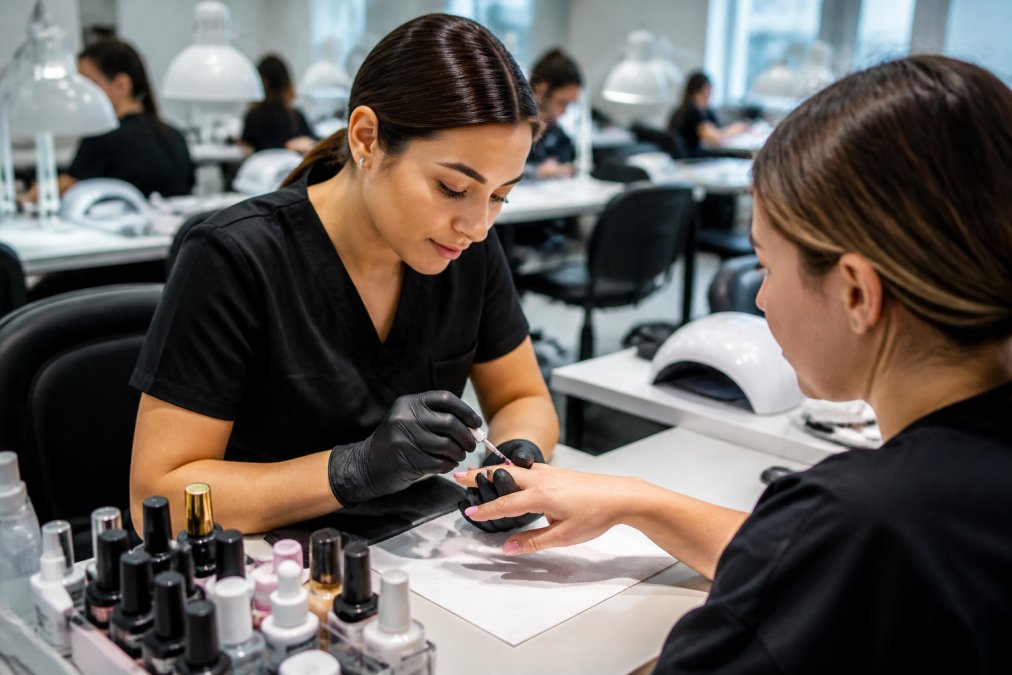
Gel and acrylic are the two systems students will use daily for their entire careers, so the classroom should teach on the same products they'll buy later. Consistency matters more than variety here. If your curriculum switches gel brands mid-semester, students relearn viscosity and cure times instead of technique.
HEMA-Free and Vegan Options for Student Safety
HEMA is the monomer that triggers most gel allergies, and students overexposed during training are the highest-risk group. The nail art gel segment is growing at a 6.02% CAGR through 2032 (Introspective Market Research on nail art gel growth), and a large share of that growth is HEMA-free formulation. Stocking HEMA-free and vegan gel as your default, not your upgrade, removes the problem before it starts.
Opening a Professional Nail Supply Wholesale Account
A professional nail supply wholesale account is a trade-only purchasing agreement that gives verified salons, schools, and technicians access to distributor pricing, usually with a minimum order threshold and business documentation on file. For schools, the account should be in the institution's name with the program coordinator listed as an authorized buyer, so purchasing survives staff turnover.
Documentation and Trade-Only Access
Expect to provide a business license or institutional registration, a GST number, and proof of professional status for the named buyers. Trade-only access exists to keep professional-grade products out of retail channels, and it's why the pricing looks different from what your students see online. Keep your documentation current. Accounts that lapse into "pending verification" mid-semester hold up orders at the worst possible time.
Nail Salon Inventory Loss Prevention in School Settings
Nail salon inventory loss prevention in a school is a different problem than in a salon. You're not watching for theft so much as evaporation: product consumed in practice, tools that walk off, and open bottles that dry out between cohorts. The fix is process, not suspicion, and for a new program, the fix starts before the first intake.
Stocking a Classroom From Zero
A new school has no consumption history, so the first order is always a guess. The way to make it a good guess is to size the opening stock to contact hours rather than to student count. A cohort running 20 hours of gel practical per week will consume gel, prep, and top coat at a rate that has nothing to do with how many students are enrolled and everything to do with how many hours the lamps are on.
OPI Gel Colour - Beauty School Popout →
- Durable kit items at one per student, plus 10 percent spares for breakage and warranty swaps
- Consumables at roughly one term's worth based on your practical-hour estimate, not a full year
- Disinfectant and single-use items at the higher end of your estimate, since these are the items that trigger emergency reorders fastest
- Backup units of your two most-used tools (lamp and file) so a single failure doesn't stall a practical assessment
The Reorder Mechanism That Actually Works
A reorder point is only useful if it is set per SKU and tied to lead time. The formula most coordinators use: reorder point equals average weekly consumption multiplied by supplier lead time in weeks, plus a safety buffer for the two weeks around intake when demand spikes.
- Assign numbered kits to individual students and log them in and out
- Keep bulk product behind the instructor station, decanted into labeled working bottles
- Photograph the supply room at the start and end of each term
- Reconcile your top ten SKUs monthly against your order history
- Set a reorder point per SKU rather than ordering when shelves look empty
- Review consumption per cohort at the end of each term and adjust the next opening order
Salon Equipment, Furniture, and Spa Essentials for Training Spaces
Salon equipment and furniture take more abuse in a training environment than in any working salon. Twenty students adjusting the same chair, running the same lamp, and dragging the same trolley will expose every weak hinge and thin laminate within a semester. Buy commercial-grade, and buy for repairability.
The categories worth specifying carefully:
- Nail salon furniture: manicure tables with adjustable height, vented work surfaces, and replaceable tops
- Manicure and pedicure supplies: stainless implements, autoclavable trays, and enough sets for your cohort size
- Esthetics supplies and spa essentials: treatment beds, trolleys, and linens that survive industrial laundering
- Nail care accessories: cuticle softener in bulk sizes, files by grit, and prep solutions
Shipping, Order Fulfillment, and Restocking for Schools
What most guides miss is that schools don't need the fastest shipping, they need predictable shipping. A distributor that delivers in four days every time beats one that delivers in two days sometimes.
Conclusion: Building a Reliable Supply Chain for the Next Generation of Nail Techs
Every program eventually hits the same wall: the curriculum is solid, the instructor is excellent, and the supply chain is the thing letting students down. Fixing that means choosing a wholesale partner on stock depth, trade pricing, and delivery reliability rather than on a single low quote.
Frequently Asked Questions
What are the requirements for opening a beauty school in Canada?
Requirements vary by province, but most beauty schools need provincial registration and a curriculum that meets industry standards. Programs must include practical assessments to verify technical proficiency. Schools also need appropriate training equipment, qualified instructors, and a facility that meets health and safety regulations. Many institutions partner with wholesale nail supply distributors to standardize student kits and bridge the gap between training and professional practice.
How do I qualify for wholesale pricing on nail supplies?
To open a professional nail supply wholesale account, you typically need a valid business license, proof of trade status such as a beauty school registration or salon license, and a completed account application. Distributors like Classique Nail Supply offer trade-only access to verified professionals and institutions. Once approved, you get distributor pricing on bulk orders, access to industry-standard brands, and dedicated customer support. Setting up an account before your first semester starts ensures you can place large training orders without delays.
What essential nail products should beauty schools stock for students?
Core supplies include gel polish systems, acrylic powder, UV/LED lamps, nail files in multiple grits, electric nail files, manicure implements, pedicure supplies, and sanitization products. For training kits specifically, add nail prep solutions, top coat and base coat, nail art brushes, and student starter kits with professional-grade tools. Classique Nail Supply recommends HEMA-Free and vegan options for classroom safety. Stock enough volume for peak enrollment periods and keep backup units of high-use items like cuticle softener.
How can beauty schools manage inventory loss effectively?
Nail salon inventory loss prevention in schools starts with a checked-out system for reusable tools and locked storage for consumables. Track product usage per student module and assign kit audits at the end of each term. Order bulk sizes where possible to reduce individual unit loss. Train students on proper sanitization protocols and product care so supplies last longer. A simple spreadsheet or inventory app can flag when restocking is needed before you run out mid-class.
Are there specific safety standards for nail products used in Canadian schools?
Yes. Canadian beauty schools must follow provincial health and safety regulations, which include proper ventilation for acrylic and gel systems, skin-safe product formulations, and sanitization protocols for reusable implements. Many schools now prioritize HEMA-Free and vegan gel polish to reduce allergy risk among students. Check with your provincial regulator for specific requirements on chemical storage, ventilation, and waste disposal in training facilities.
How fast is shipping for wholesale orders to beauty schools?
Shipping speed depends on the distributor and your location. Classique Nail Supply offers fast shipping across Canada, with order fulfillment typically processed within 1-2 business days. For schools ordering mid-week, this means restocking high-demand items without waiting 10 days. To avoid class disruptions, place bulk orders at the start of each semester and keep a buffer stock of your top 5 most-used products. Some distributors offer expedited options for urgent training kit needs, so confirm turnaround times when opening your wholesale account.