
Last Updated: October 25, 2026
Quick Summary
To verify authentic professional nail brands, compare suspect bottles against a confirmed-genuine control under daylight-balanced light, checking label typography, color fidelity, substrate quality, and bottle geometry. Verify batch codes through the brand's official lookup tool, customer service, or authorized distributor, and request complete documentation including ingredient lists and current Safety Data Sheets. Buy only from authorized distributors listed on the manufacturer's official website.
- Counterfeit gel polish chips within days instead of lasting three weeks and may feel thick, grainy, or separated
- Batch codes should match between the bottle and outer carton; a mismatch is a strong warning sign of counterfeits
- Legitimate manufacturers provide ingredient lists and current Safety Data Sheets freely; refusal to provide them is a red flag
- Test samples on practice nails for one full week before committing to bulk orders to reveal performance issues early
- Authorized distributors are vetted by manufacturers, maintain proper storage, and can verify batch codes and provide authentic documentation
Table of Contents
- Why Verifying Authentic Professional Nail Products Matters
- Check the Packaging and Labeling for Quality Standards
- How to Check Nail Polish Batch Codes and Traceability
- How to Spot Counterfeit Gel Polish and Warning Signs
- Verify Product Documentation and Ingredient Information
- Authorized Professional Nail Product Distributors and Direct Verification
- Use a Professional Nail Product Authenticity Checklist
- Request Sample Testing Before Committing to Bulk Orders
- Frequently Asked Questions
Why Verifying Authentic Professional Nail Products Matters
Counterfeit professional nail products look legitimate but perform poorly, damage nails, and waste money. Learning to verify authentic professional nail brands protects your business and clients.
A fake gel polish might chip within days instead of lasting three weeks; a counterfeit acrylic system might crack or yellow. Your reputation takes the hit, not the supplier.
This guide covers packaging checks, batch code verification, documentation review, and safe sourcing so you can verify authentic professional nail brands before you buy.
Check the Packaging and Labeling for Quality Standards
The real skill is comparing a suspect bottle against a known-genuine reference so you make an evidence-based call, not a gut-feel one.
Build a reference set before you need it
Keep one confirmed-genuine bottle of each brand and product type you stock, labeled with date and batch code. Compare new shipments against it side by side under the same lighting; without a control, you are guessing.
Without a control bottle, ask the brand's authorized distributor for a verified sample, or photograph a genuine unit at a trade show, capturing the front label, back label, base, and cap.
The four-point packaging comparison
Run every suspect unit through these four checks against your control:
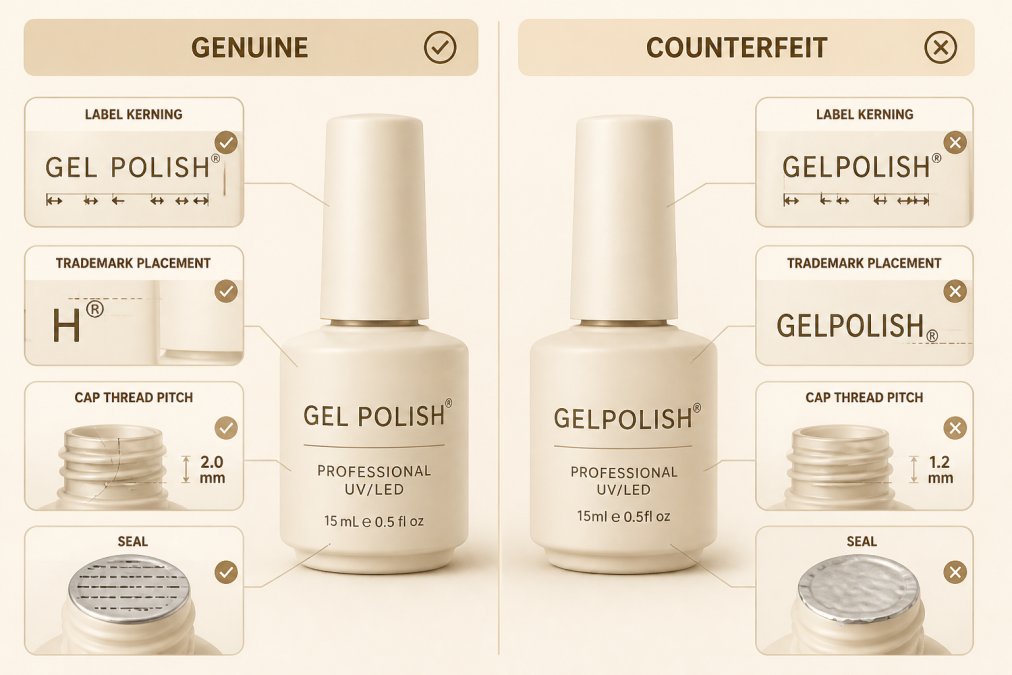
- Label typography and kerning. Genuine labels use consistent letter spacing. Counterfeits often show uneven gaps, a different font weight, or a misplaced ® or ™ mark, counterfeiters frequently get this wrong.
- Color fidelity. Hold the suspect bottle next to the control under daylight-balanced light, not salon fluorescents. Counterfeit printing often shifts a shade or two, a red that reads orange, a black that reads charcoal. Genuine batch variation is minimal; a visible shift is a warning sign.
- Label substrate and adhesive. Genuine professional labels usually use a film or coated stock that resists acetone and alcohol. Wipe an inconspicuous corner with isopropyl alcohol; if the ink smears or the label lifts, the substrate is likely wrong. Do not do this on the front of a bottle you intend to sell.
- Bottle, cap, and closure geometry. Measure the cap diameter and bottle height with calipers if you have them. Counterfeit molds are often slightly off, a loose cap, a misplaced seam line, or a base a millimeter taller. Genuine caps should seat with the same number of turns as your control.
Tamper evidence and seal checks
Genuine professional products usually ship with a specific seal, shrink band, security sticker, or foil induction seal. Note the exact seal on your control: color, width, and any brand mark or batch-specific code.
Red flags on seals:
- A seal that is missing entirely on a product that normally has one
- A generic seal with no brand marking where the control has one
- A seal that has been cut and re-applied, leaving adhesive residue
What packaging cannot tell you
Packaging checks catch sloppy counterfeits but not high-quality fakes with copied labels and cloned bottles. Pair them with the batch-code and documentation checks below; treat packaging as a screening test, not a verdict.
How to Check Nail Polish Batch Codes and Traceability
Batch codes are the most useful authenticity signal on a professional nail product, but many brands publish no public tool and confirm codes only through an authorized distributor. Here's how to read a code, verify it through the right channel, and handle a brand that won't confirm directly.
What a batch code actually encodes
A batch code (lot code) is a short alphanumeric string identifying the production run, and often the date and facility, of a specific unit. Formats vary by brand but usually encode:
- Year and month of manufacture, often as a two-digit year plus a letter for the month (A = January, B = February, and so on), or as a Julian date
- Facility or line identifier, a letter or number that maps to a specific production site
- Run number, a sequential number for that production batch
You don't need to decode the format yourself. What matters is that the code exists, follows the brand's documented format, and traces back to manufacturer records.
Where to find the code
Batch codes are usually printed, stamped, or laser-etched on the bottle base, the back or bottom edge of the label, the crimp or shoulder, or the outer carton if boxed.
On a genuine product, the code on the bottle and the code on the outer carton should match. A mismatch is a strong warning sign, it suggests the bottle and box were sourced separately.
How to verify a code through the right channel
Direct brand verification is the gold standard but not always available. Work through these channels in order:
- Brand's official batch-lookup tool. Some larger brands publish a lookup page. Enter the code exactly as printed, including any spaces or hyphens.
- Brand customer service. Email a photo of the code and bottle base plus your invoice. Ask the brand to confirm the code matches their production records and that the product was sold through an authorized channel.
- Authorized distributor. If the brand does not deal with end users directly, your authorized distributor can often run the code against brand records, the most common route for professional-only lines.
- Trade or professional account manager. If you hold a professional account, your account manager can usually confirm a code quickly.
When the brand will not or cannot verify
Not every brand offers public verification. If you can't get direct confirmation, treat it as an unresolved signal, not proof of a fake. Then:
- Confirm the code format matches other genuine units of the same brand you have on hand
- Confirm the code is physically consistent, stamped or etched the same way, in the same location, with the same font as your control
- Ask your authorized distributor to confirm the code against their purchase records from the brand
Build a batch log
Log every professional product you receive: date, supplier, product name, shade, batch code, and a photo of the code.
A batch log also protects you in disputes: suppliers respond far better to an exact code, invoice, and failure pattern than a general complaint.
How to Spot Counterfeit Gel Polish and Warning Signs
Counterfeit gel polish looks similar to authentic gel at first glance. But performance reveals the truth quickly.
Watch for these warning signs of counterfeit gel polish:
- Inconsistent color application (streaky or patchy)
- Poor adhesion (lifts or peels after a few days)
- Chips or cracks within a week instead of three weeks
The gel should self-level and flow smoothly without clumping. If it feels thick or grainy, something is wrong.
Test a small batch before bulk orders: apply to practice nails, cure properly, and observe wear over one week.
Authentic professional gel cures under proper UV or LED lamps.
Verify Product Documentation and Ingredient Information
Authentic professional nail products come with detailed documentation: ingredient lists, safety data sheets, and application instructions.
Request these documents from your supplier before purchasing:
CND Shellac (HEMA/TPO-Free) - Tartan Punk #196 (0.42oz) →
- Complete ingredient list
- Safety Data Sheet (SDS)
- Application and removal instructions
Legitimate manufacturers provide this freely; a supplier who refuses or delays is a red flag.
Review the ingredient list carefully. Look for information about nail polish composition and toxic components to understand what you're working with.
Safety Data Sheets detail hazards, handling precautions, and first-aid measures.
Check the SDS date. Authentic manufacturers update their sheets regularly.
Compare documentation across multiple bottles from the same brand.
Authorized Professional Nail Product Distributors and Direct Verification
Buy from authorized distributors only. This is your strongest defense against counterfeit products.
To find authorized distributors:
- Visit the brand's official website
- Look for a "Where to Buy" or "Authorized Retailers" page
- Contact the brand directly and ask for a list of authorized distributors in your area
- Verify that your supplier appears on the official list
Explore top professional nail supply sources in Canada to find reputable retailers where you can purchase authentic products with confidence.
Ask your supplier directly: "Are you an authorized distributor for this brand?" Legitimate distributors answer confidently and can provide proof.
Check where to buy authentic Akzentz products in Canada to see examples of authorized distribution channels.
Avoid third-party marketplaces with suspiciously low prices.
Contact the manufacturer directly if you're unsure about a distributor. Most brands verify authorized retailers instantly.
Use a Professional Nail Product Authenticity Checklist
Create a repeatable system to verify authenticity before every purchase so you never miss a warning sign.
Use a professional nail product authenticity checklist as your verification tool. Check every box before accepting a shipment.
Here's a basic checklist to get started:
- Packaging is pristine with sharp, aligned printing
- All text is spelled correctly with no grammar errors
- Labels are smooth and securely attached
Print this checklist and keep it at your station. Use it every time you receive a new product. This creates accountability and protects your business.
| Verification Step | What to Check | Red Flags |
|---|---|---|
| Packaging | Sharp printing, aligned labels, secure attachment | Blurry text, peeling labels, misalignment |
| Batch Code | Visible code matching brand format | Missing code, illegible marking, wrong format |
| Documentation | Complete ingredient list, current SDS | Missing sheets, outdated information |
| Supplier Status | Authorized distributor verification | Unclear authorization, unresponsive supplier |
| Product Performance | Consistent application, proper wear time | Chips within days, poor adhesion, separation |
Request Sample Testing Before Committing to Bulk Orders
Never buy a large quantity of a new product without testing it first.
Contact your potential supplier and request samples.
Keep detailed notes:
- Application ease (did it flow smoothly?)
- Curing time (did it cure properly?)
- Wear duration (how long before chips appeared?)
Compare samples from different suppliers if possible.
Ask other nail technicians about the product.
Request a detailed brand-specific verification guide for popular gel brands to learn product-specific testing tips.
Document everything: keep sample bottles, curing notes, and wear observations.
Classique Nail Supply carries only authentic professional nail products from trusted manufacturers.
Frequently Asked Questions
How can you tell if a professional nail product is authentic?
Authentic professional nail products show clear, aligned printing on labels with a batch code that matches the brand's format. Check for proper packaging weight, consistent color, and included safety documentation. Contact the manufacturer directly with the batch number to verify production records. Counterfeit products often have smudged labels, missing batch codes, or inconsistent texture. Request sample testing before ordering bulk quantities to confirm performance and ingredient integrity.
What are the signs of counterfeit gel polish?
Counterfeit gel polish typically has uneven or misaligned label printing, missing or illegible batch codes, and inconsistent formula texture. The bottle may feel lighter than authentic versions, and the polish may not cure properly or deliver the promised wear. Packaging may lack safety information or ingredient lists. Verify the product through an authorized distributor and compare application performance with known authentic samples. If performance differs significantly, escalate to the manufacturer with photos and batch details.
How do you verify that a nail supplier is an authorized seller?
Contact the brand's official customer service or check their website for a list of authorized distributors. Verify the supplier's business credentials, registration, and physical address. Ask the supplier directly for proof of authorization or a distributor agreement. Check customer testimonials and references from other salon owners or technicians. Authorized distributors typically offer consistent pricing, reliable stock, and direct support from the brand. Be cautious of suppliers offering unusually low prices or claiming exclusive access to out-of-stock items.
What information should be on professional nail product packaging?
Professional nail product packaging must include a clear brand name and logo, product name and shade number, batch code or lot number, volume or weight, application instructions, curing time, and wear duration claims (e.g., up to 21 days). Safety information, ingredient list, and removal instructions should be present. The label should display the manufacturer's name and contact details. For gel polish, HEMA-free or TPO-free claims should be clearly marked if applicable. All text should be legible, properly aligned, and free of spelling errors or smudging.
