

Last Updated: November 24, 2026
Quick Summary
A nail product store should carry a broad, well-organized range of gel polish, base and top coats, acrylic systems, builder gels, nail art supplies, and professional tools. Look for multiple brands in each category, clear product descriptions, consistent restocking, and easy reordering.
- Look for multiple brands in each category to match products to client needs and budgets.
- Clear descriptions listing ingredients, intended use, and compatibility prevent guesswork.
- Ask about stock visibility before committing, since sold-out top shades can cost clients.
- Choose a starter acrylic kit within one monomer and powder system from the same manufacturer.
- Keep base coat, colour, and top coat in the same product family where possible.
Table of Contents
- What a Nail Product Store Should Offer a Working Professional
- Professional Nail Supplies Versus Retail Nail Products
- Building an Acrylic Nail Kit by Skill Level
- Gel Polish, Base Coats and Choosing the Right Nail Lamp
- Nail Art Supplies and Accessories Worth Stocking
- Ingredient Safety, Ventilation and Hema-Free Options
- Shipping, Stock Levels and Buying Criteria Before You Order
- Opening a Trial Order With Classique Nail Supply
- Frequently Asked Questions
What a Nail Product Store Should Offer a Working Professional
Choosing a nail product store is one of the most important supply decisions a nail technician makes. The right shop saves time, protects your margins, and keeps your service menu consistent. This guide starts with what a dependable nail product store should actually provide for salon owners, mobile techs, and beauty school instructors.
A nail product store that serves working professionals should carry a broad, well-organized range: gel polish, base and top coats, acrylic systems, builder gels, nail art supplies, and professional tools. Breadth matters, but so does depth.
Pay attention to how the store handles the details that affect your day. Clear product descriptions that list ingredients, intended use, and compatibility save you from guessing. Consistent restocking matters just as much. A top color that sells out for two weeks can cost you a client, which is why stock visibility is worth asking about before you commit.
Finally, a professional-focused store should make reordering easy. Account features, order history, and straightforward shipping details reduce the time you spend on admin so you can spend it on clients.
Professional Nail Supplies Versus Retail Nail Products
Professional nail supplies are formulated and packaged for salon use, while retail nail products are often designed for quick at-home application. The difference shows up in pigment load, curing behaviour, bottle sizing, and how the product performs under repeated use.
Professional-grade products are generally sold in larger sizes and are formulated for the volume a busy station demands. Retail versions can be perfectly good for personal use.
When you evaluate a store, ask whether it distinguishes between these categories. A shop that clearly labels professional lines, offers bulk sizes, and explains intended use is far more useful than one that lists everything under a single heading.
The table below sums up how the two categories differ, based on the points covered above.
| Category | Typical packaging | Intended use |
|---|---|---|
| Professional nail supplies | Larger sizes | Salon use |
| Retail nail products | Smaller sizes | Quick at-home application |
Building an Acrylic Nail Kit by Skill Level
A well-built acrylic kit depends on your experience. Beginners need reliable basics that are forgiving to work with, while experienced techs can add specialty products that speed up their work or expand their service range. The most common mistake is buying a large kit before knowing which services you will actually perform. Start with the three or four services you book most often and expand from there.
Starter Kit: What a Beginner Actually Needs
For a first acrylic setup, stay within one monomer-and-powder system from the same manufacturer. Mixing a monomer from one line with a powder from another is the usual cause of poor adhesion, cloudy cure, or a product that sets too fast or too slow. A starter kit should include:
- One monomer and one powder in a matching system, plus a small set of cover and natural shades
- A dehydrator or primer suited to that system
- A set of oval or flat brushes in at least two sizes (one for application, one for detail)
- Files in 100/180 grit, a buffer block, and a dust brush
- Tips or forms, cuticle pusher, and nippers
- A dappen dish and lint-free wipes
Beginners should avoid specialty powders (glitter, colored, or hard-to-work formulations) until they can control bead ratio and placement on a basic set. A forgiving powder with a slower set time gives more room to correct mistakes before the product hardens.
Intermediate Additions
Once basic application is consistent, intermediate techs can add builder gel for structure and overlays, along with a wider range of tips and forms.
At this stage, add a second powder shade range for French and ombre work, a finer detail brush, and a small selection of art gels. Keep the same monomer system unless you deliberately switch, because changing systems mid-kit reintroduces the compatibility problem.
Advanced and Specialty Additions
Experienced techs can add colored and glitter powders, sculpting forms in multiple sizes, and a second lamp or e-file for faster finishing. Specialty products are worth adding only when you have repeat demand for the service they support. A common pattern is to add one specialty powder per quarter and test it on a small number of clients before stocking it in quantity.
Skill-Level Buying Checklist
Before ordering, match each item to a skill level and a service you already book. If a product does not support a service on your menu, it is not a starter item. Keep the first order small enough to test performance, packaging, and shipping before committing to bulk sizes.
Gel Polish, Base Coats and Choosing the Right Nail Lamp
Gel polish needs three things to perform well: a compatible base coat, a colour or top coat matched to the same system, and a lamp that cures the product fully. Mixing brands across these steps is where most gel problems start, including lifting, incomplete curing, and a tacky finish.
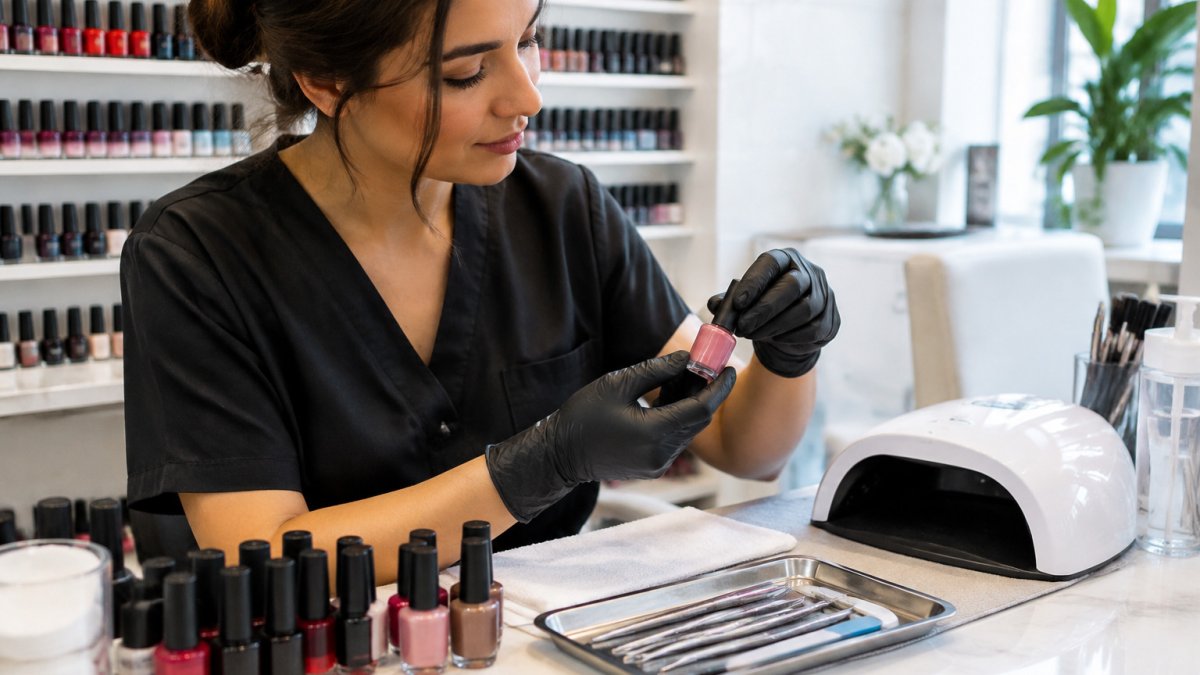
Keep the base coat, colour, and top coat in the same product family where possible.
!A nail technician in a bright salon station selecting a gel polish bottle beside a curing lamp and a tray of tools
Matching Lamp Wattage and Curing Time to Your Gel Brand
Lamp wattage alone does not tell you whether a lamp will cure your product. Check the manufacturer's recommended curing time and lamp type, since some gels are formulated for LED curing and others for UV or hybrid lamps.
Before buying a lamp, confirm it matches the gel brands you use.
Nail Art Supplies and Accessories Worth Stocking
Nail art adds perceived value to a service, and the right accessories make it repeatable. Stock a core set: fine liner brushes, dotting tools, striping tape, stamping plates, and a small range of art gels or polishes in neutral and bold shades. These items are inexpensive relative to the services they support.
Nail accessories such as cuticle nippers, cuticle oil, and nail clippers round out a complete station. Keep at least two sizes of tip cutters and file grits so you are never stuck mid-appointment.
Ingredient Safety, Ventilation and Hema-Free Options
Ingredient safety is one of the most important factors when choosing products. Some gel and acrylic formulations contain HEMA, a known sensitizer that can cause allergic reactions in clients and technicians. Reading ingredient lists and asking the store about allergen information is a responsible step for any professional.
Ventilation matters too. Work in a well-ventilated space, keep lids closed when not in use, and follow the manufacturer's safety data for handling. Clients with known sensitivities should be offered HEMA-free options,
When looking for HEMA-free gel polish, compare brand claims carefully and check current product labels, since formulations change. Our guide to the best HEMA-free gel polish brands in 2026 covers what to look for.
Shipping, Stock Levels and Buying Criteria Before You Order
Before placing an order, check four things: shipping times, stock status, minimum order requirements, and return or exchange policies. When restocking a top-selling shade, ask about estimated delivery windows, whether the store ships mid-week, and how stock levels are updated. Clear, current stock information matters when you have appointments already booked.
Compatibility and Complete System Planning
The most overlooked buying criterion is compatibility. Prep products, base coats, gels, lamps, and removers are designed to work as a system. A base coat from one line may not bond to a color from another, and a lamp that cures one brand's gel may under-cure another's. Before you order, map each product to the system it belongs to and confirm the lamp and curing time match. If you run multiple systems, label them at the station so products are not mixed by accident.
Watch out: buying a remover or cleanser that is not matched to your gel system can leave residue that shortens the life of the next set.
Cost Per Service, Not Sticker Price
Compare pricing by cost per usable unit, not just sticker price, and only buy larger bottles if you will use them before they expire. Check the shelf life and storage instructions for each product, and rotate stock so older bottles are used first. Pricing depends on quantity, dates, and delivery, so check the store's website for current prices or request a quote before you commit.
Care, Removal and Product Lifespan
Plan for aftercare and removal at the buying stage. Stock the remover, files, and cuticle oil that match your gel or acrylic system, and keep removal instructions on hand for clients. Products stored away from heat and direct light last longer; most manufacturers print a shelf life or open-jar date on the label. A store that publishes storage and removal guidance saves you from guessing and reduces waste.
A Simple Pre-Order Checklist
- Confirm shipping windows and whether the store ships mid-week
- Check stock status and backorder policy for top-selling shades
- Verify minimum order requirements and return or exchange terms
- Map each product to its system and confirm lamp and curing compatibility
- Compare cost per service and check shelf life before buying bulk
- Confirm removal and aftercare products are in stock alongside the main order
Opening a Trial Order With Classique Nail Supply
A trial order is the lowest-risk way to evaluate a new supplier. Start with a focused selection: one base coat, two or three top-selling colours, a few tools you use daily, and any product you are curious about. This lets you test product performance, packaging, and shipping before committing to a larger account.
Classique Nail Supply offers a comprehensive selection of premium products, including gel polish and acrylic systems, with fast shipping across Canada. You can browse our selection and current offers on our website, then place a trial order that fits your station and your client list.
Frequently Asked Questions
What should I look for in a nail product store?
Start with the range: a store serving working professionals should carry gel polish, builder gels, acrylic powders, lamps, and tools in consistent lines rather than a few scattered items. Check whether product descriptions state the ingredient profile, including whether a line is Hema-Free, and whether the listed brands are in stock rather than marked backordered. Ask about shipping times across Canada, since a delayed restock can cost you a client booking. Finally, confirm that pricing is shown clearly and that current prices are available on the website or by quote, because costs vary with quantity, dates, and delivery.
Where can nail technicians buy professional nail supplies online?
Canadian nail technicians often buy professional nail supplies from specialist online retailers that ship nationally, as well as from local beauty supply stores and salon distributors. When comparing options, look at product breadth, stock reliability, and whether the store explains product compatibility, such as which base coat works with which gel. Classique Nail Supply lists its professional range on its website, and current pricing or a quote is available there.
What supplies do I need to start doing acrylic nails?
A basic acrylic nail kit includes a liquid monomer, acrylic powder in a clear and a pink shade, a dappen dish, a brush sized for sculpting, nail forms or tips, a file and buffer, and a cuticle pusher with nippers. Beginners often add a dehydrator and primer to improve adhesion. Build the kit in stages: start with a core set of two or three powder colours and expand once you know your preferred application technique and product line.
How do I choose the right nail lamp for gel polish?
Match the lamp to the gel you use most. Check the manufacturer's recommended curing wavelength and time for each gel, since some formulas cure under LED light in 30 to 60 seconds while others need longer exposure. Also consider the lamp's size, whether it has a timer and sensor, and whether it handles the nail art gels or builder gels in your range. Using a lamp outside a gel's recommended specification can leave the polish tacky or reduce durability.


